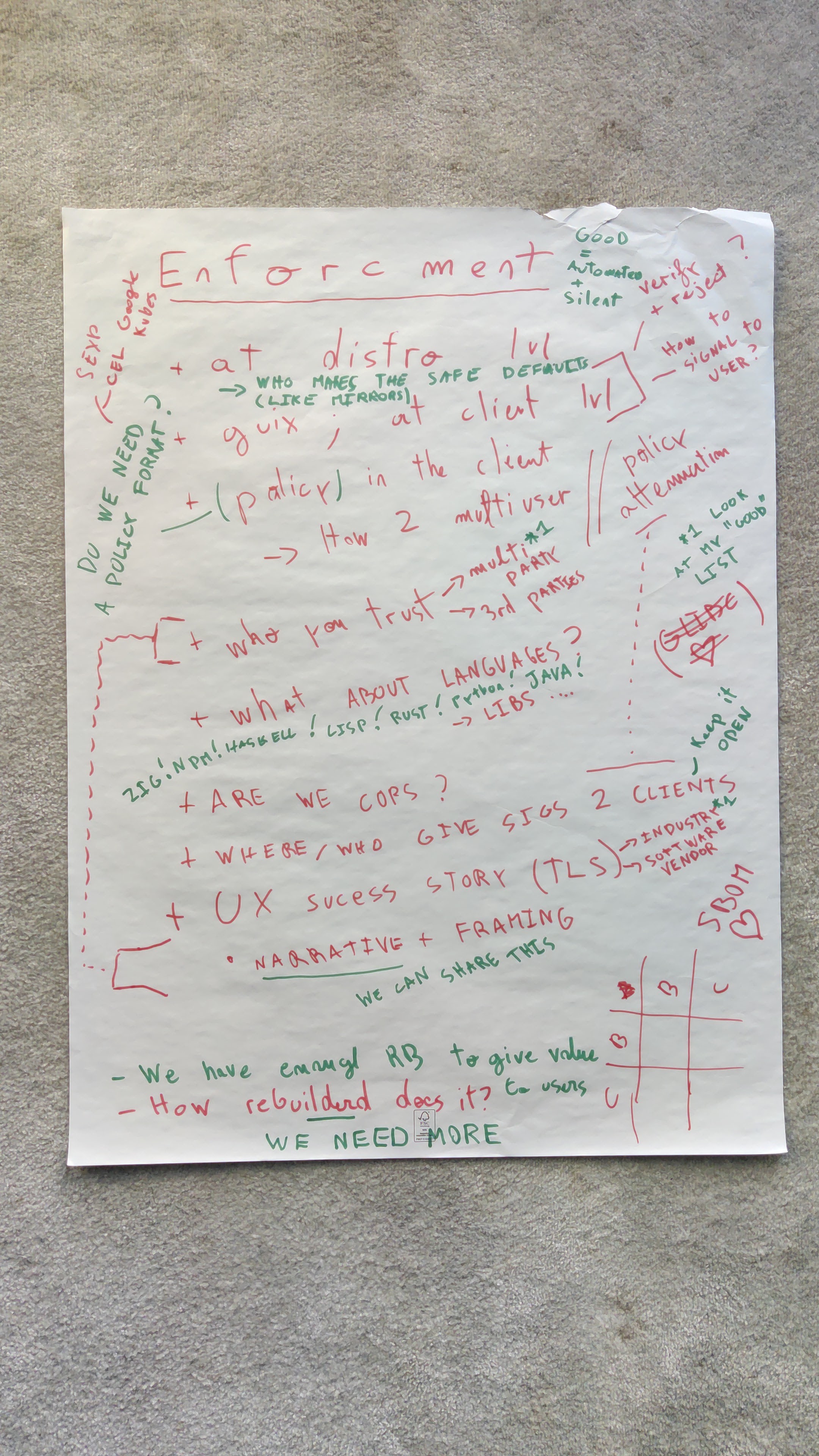
Gothenburg 2026 - Day 2 - Enforcement
Enforcement
- At distro level, the gatekeeping is at entering the archive
- guix, enforcement can be done at client level
- policy attenuation, as an owner of a machine, I can set policy, can other users of the machine set policy regarding reproducible builds?
- And/or narrow who you trust for providing binaries
- Could this enforcement be made on a language level
- What about languages? Is it possible for authors of specific libraries to enforce reproduvible builds?
-
Approaches mentioned in the “avoiding the 1%” discussion yesterday
- repro-threshold (client side)
- a conflicts package (archive side)
- splitting repositories (archive side)
- …
- One fustration mentioned yesterday, adding information next to the package inside the archive isn’t easy
- If a client is looking for multiple signatures, where does the client get them from?
- If this requires changes in the server/archive side, this can cause delays in people making use of this
- ATProto provides a separation between identity and storage
- What is a success story for this?
- TLS
- Success story for industry, proof by paperwork works less and less, need an approach that applies for companies building and distributing software
- If done correctly, maybe this encourages more people to build and publish signatures for software
- Does enforcement intersect with transparency logs? For WebPKI, trust depends on the signatures being public and logged
- The automatic monitoring of this is a good security check, so entities can automatically check if unexpected signatures emerge, and then act if there seem to be security issues
-
Automation and being silent when things are going well as important
-
We have enough things building reproducibly to give some value to users
-
Maybe Google’s CEL language is useful for policies https://cel.dev/
-
Languages and language package managers have issues
- Who sets the safe default policy?
- Distro?