Gothenburg 2026 - Day 3 - Enforcement, part 2
Follow-up of a session on day 2
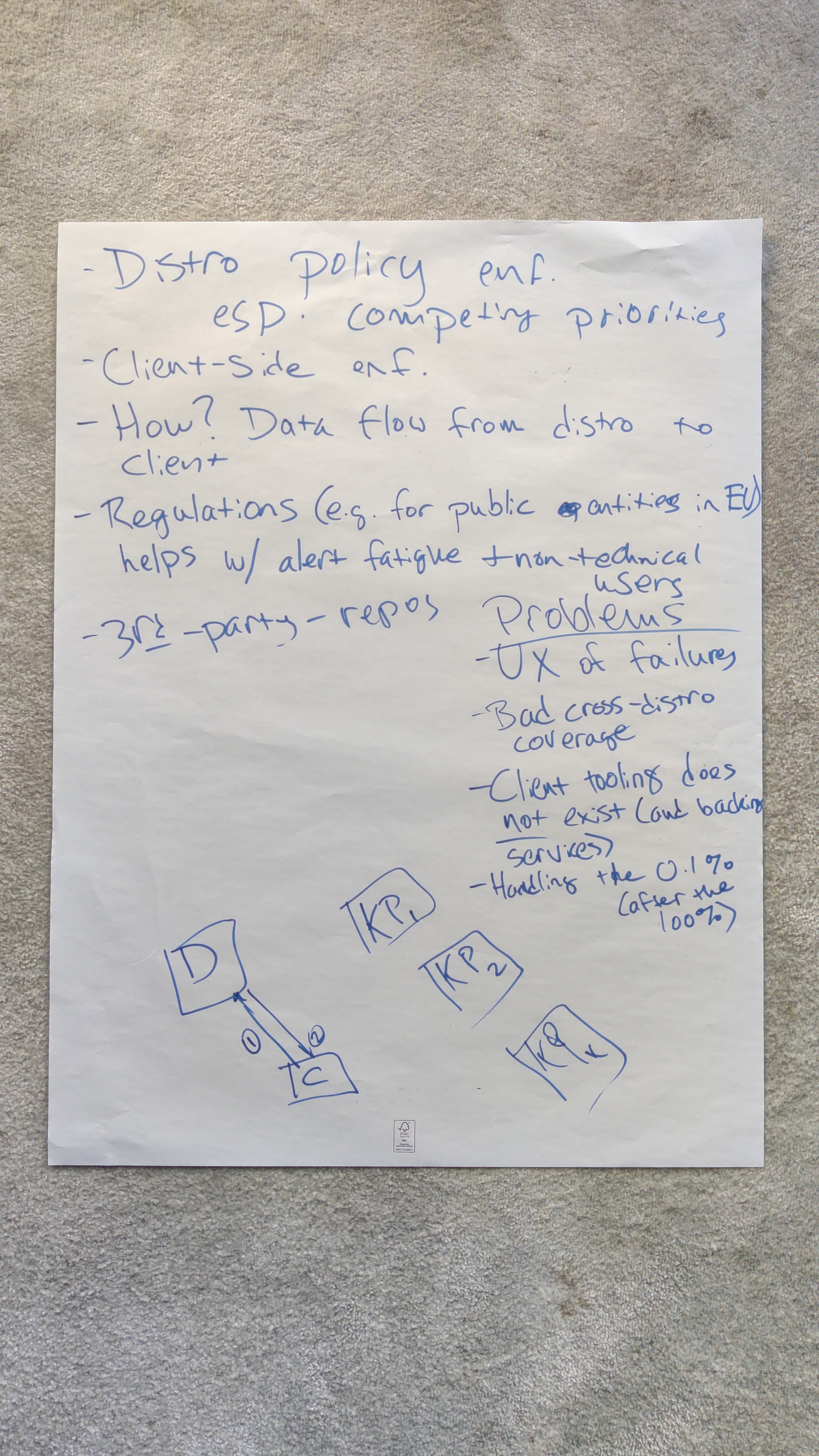
- Distro policy, where reproducible builds block updating packages
- People can bypass this by asking for things to
- Client side enforcement
- Where can we put enforcement? How do we move information around?
- Meta-enforcement, EU?, software that offers public services should be open source and build reproducibly
- There’s a German startup which helps with reproducible docker images (Zendis, L3monTree, devguard.org)
- State in Arch at the moment, 70% at the moment is reproducible, so enforcing client side would break installs
- Fallback building from source
- People don’t care about reproducibility, they care about trust
- Profile guided optimisation is still an issue, but distros already target a broad range of hardware support over speed
- Focusing on the client side experience is good, then you can work backwards to inform other things
- What do you expect to happen if some core package is non-reproducibe?
- One idea, some kind of poilcy, with exceptions to handle this case
- Users might need software that doesn’t build reproduucibly, so they might feel that they don’t have a choice
- There’s a need to handle this on a ongoing basis, since reproducibility issues will still crop up in the future
- There’s some benefits already from reproducible builds, e.g. small fixes don’t have uninteded consequences
- Maybe a downside with client side verification can lead you with an inconsistent repo state
- You could have a setup where non-reproducible packages are held back, rather than being shown to clients but not being installable
- What are the unsolved problems with the space, on both the client and server side?
- How should users see this, if at all, how should failures be surfaced?
- On a distro level, many distributions don’t have a policy on reproducible builds
- Lack of tooling on the client side
- Protocol definitions, e.g. rebuilderd interoperating with oss-rebuild
- Should clients connect out to find signatures from the different sources they trust, or should these be batched up?
- Can transparency logs be used?
- Handling the remaining 1% non-reproducible things.
- Path forward with profile guided optimisation?
- In Debian, maybe two paths forward, accept some non-reproducible packages, fix the non-reproducibility
- For source based distros, Guix, Nixpkgs, Gentoo, … some of these problems are easier to get around, since you can fall back to building from source
- TLS is a helpful model here.
- Practical issues on verifying reproduuucibility
- Verifiers go down
- Is it enough to claim that all a distro’s packages are reproducible?
- How do things work for 3rd party repositories?
- Policy on a package level?
- Exceptions on a package level
- APT implementation details
- Easy sketch
- How does this work for airgapped environments?